วันพฤหัสบดีที่ 24 พฤศจิกายน พ.ศ. 2559

Writing a CV or Résumé
What is a CV or Résumé?
In simple terms, your CV or resume sets out your skills and experience.
Your CV should demonstrate to any potential employer why they should hire you above any of the other skilled candidates who have presented themselves for employment.
In practice, plenty of CVs do anything but that!
Technically a CV (Curriculum Vitae) is a detailed document outlining all of your life achievements, qualifications, associations, awards and skills. Curriculum Vitae means ‘course of life’ in Latin. 
A resume (spelt résumé, with accents, in its technical form), is a more concise document; an abbreviated version of your CV that focuses on specific skills and achievements, usually in relation and relevant to an employment opportunity.
However, for the sake of this page the terms CV and résumé are interchangeable. 
In the UK and Ireland, job applicants are usually required to produce a CV whereas in the US and Canada the word resume is more frequently used. 
In India, Australia and other English speaking counties either term may be used – for the purpose of applying for a job CVs and resumes are the same thing, it just depends on where the job is!
This page sets out some of the ‘dos’ and ‘don’ts’ of CV writing to help you avoid some of the worst pitfalls and prepare a resume that will stand out from the crowd for all the right reasons.
Things You Should Do When Writing a CV
Include your contact details at the top
Start with your name, address, phone number and email address. If your CV runs to more than one page, then make sure you include an identifier on every page, probably as a header or footer, and page numbers.
Decide whether you want to start with a personal statement
This is optional, although many CV-writing companies recommend it. If you decide to include one, it needs to say something real about you, and not just be an anodyne statement that could apply to anyone. Try to avoid jargon such as ‘forward-thinking’ or ‘strategic’ and use this to showcase your strengths, if possible focused on action.
Include sections on Key Skills, Knowledge and Achievements, Work Experience, and Education
Precisely how much to include in each section depends on the sector to which you are applying. Try to get some advice from someone in the sector if you don’t already work there. Start with the most recent achievement, experience or training, and work backwards in each section.
When discussing achievements, focus on what you’ve actually done and the end result achieved
Your statements should be in the form “In situation x, I did this and the end result was that”.
For example:
In an unexpected funding crisis, I organised and carried out a cross-departmental review with colleagues, and managed to find savings which addressed all our funding concerns and gave us £x to put towards contingencies.
Or
As president of the climbing club at university, I sought out a commercial sponsor from contacts made during work experience and successfully obtained funding for new equipment.
Or
As chair of the college fundraising committee, I successfully organised an event which more than 200 people attend, and which raised £x. It has gone on to be a regular part of the social calendar.
Concentrate on your personal actions, the precise outcome, and how you knew the action was a success.
Include everything relevant in ‘Work Experience’ and ‘Education’
Once you’ve got plenty of work experience, it’s OK not to include the paper round you had when you were 16 and the summer jobs you had as a student, but you don’t want any gaps once you’ve started work.
If you’ve taken a career break for some reason, or had a period out of work after redundancy, say so. Otherwise you’ll be asked about it, if they don’t just assume you were in prison and bin your CV.
Don’t include every last course you’ve ever done, but do include everything that’s relevant to the job. If you’re going for a job as a forklift driver, they won’t want to know about your catering qualification, but your Health and Safety certificate might be relevant.
Check the essential requirements for the job, and make sure you’ve included anything that’s mentioned.
Make sure that your spelling and grammar are all correct
Many employers bin any CVs with spelling or grammatical errors.
Look at our pages on Grammar and Spelling, use your computer’s spell-check function, proof-read it yourself, and get someone else with good spelling and grammar to have another look before you send it.
Work on your presentation
Use a standard and professional-looking font such as Arial or Calibri, which is easy to read, and generally no smaller than 10 point for body text, larger for headings. Do not, under any circumstances, be tempted to use Comic Sans Serif.
Lay your CV out nicely on the page so that it’s easy to read and looks professional. Remember that it will probably be printed in black and white. If you’re not sure where to start with design, there are plenty of free CV templates available online.
Mistakes and Pitfalls to Avoid
Do not be tempted to lie
You will be found out sooner or later and, if a lie has got you a job, it will lose you one too.
Avoid leaving gaps in your career history
You may be ashamed that you had to spend time flipping burgers at McDonalds, and perhaps you don’t think it fits with your planned career as an astrophysicist. But, especially if you don’t have much work experience, every bit is useful and you should show what you learned from it: teamwork or time-keeping, perhaps.
Large gaps in your CV look like you’ve sat around doing nothing instead of having the initiative to go out and get a temporary job.
Do not start your CV with the dull bits
Many people make the mistake of starting with their education and qualifications. That’s really dull.
Start with your key skills, and what you’ve actually achieved in life. If potential employers like your key skills then they’ll read on to your qualifications.
Do not include your hobbies and interests
Unless of course they have developed skills that are relevant to the job.
Nobody really wants or needs to know that you do karate, or like going to the cinema. If you do include something relevant, don’t be tempted to show off by including something that sounds impressive, but isn’t really.
Murphy’s Law says that the person reading your CV will be an expert in that subject.
Be sure your sins (or exaggerations) will find you out…
As a very junior trainee in her first graduate job, Liz was astonished to pick up her telephone one day and find the company CEO on the other end of the line.
“Hello,” he said. “You know about canoeing, don’t you?”
“Yes, absolutely,” she replied. She had relied heavily on the experience gained from running a university canoe club on her CV. It was one of the few subjects she still felt certain about six weeks into the job.
“Good,” he said. “I’ve got a CV here from someone who says he’s got a One Star award in canoeing. What does that mean?”
“It’s the most basic canoeing qualification available. You can get it after a day’s course.”
“Hm. Not very impressive then,” grunted the CEO. “Have you got one?”
“Oh yes. I’m qualified to teach it.”
The candidate in question did not receive an interview. He probably never knew quite why.
Don't make your CV too long
Two pages of A4 is plenty. Nobody wants to read more. By all means make the font smaller, widen the margins and shorten the gaps between paragraphs, but no more than two pages.
Do not use an unprofessional email address
Get a professional-looking email address with your name, not a nickname. A jokey email address is fine for your friends, but it’s not OK for potential employers, and may even cause your CV to be rejected.
You may consider buying your own domain name; they are inexpensive and allow you to have a much more professional sounding email address.  So rather than cuddles1982@hotmail.com you could have jane@smithfamily.com or jane@abc-consultancy.com – depending on the availability of the domain name you want.
If you are applying for a job in a computer or internet related field then having your own domain name is particularly important for your image.
Be careful if you use the email address that is linked to your Face book page or other social media accounts.  It is very easy for potential employers to search social media sites for email addresses, which could mean they find out a lot more about you than you would like.  You may however want potential employers to find your LinkedIn account. 
You may also find our pages: Managing Your Online Presence and Writing an Effective LinkedIn Profile useful.
The Golden Rule of CV Writing
Put yourself in the recruiter’s shoes and think about what they need to know about you. The job description should give you a reasonable idea.
Use your CV to tell them what they need to know upfront and clearly, in a way that looks professional and believable. 
Your CV will not get you the job but, if done well, should give you at least a foot in the door.


วันศุกร์ที่ 3 กรกฎาคม พ.ศ. 2558

Why does Japan have such a high suicide rate?

  • 5 hours ago
  • From the section World
Last year in Japan, more than 25,000 people took their own lives.
That's 70 every day. The vast majority were men.
Those figures do not make Japan's the highest suicide rate in the world in a developing country.
That dubious title belongs to South Korea. But it is still far, far higher than virtually all other wealthy countries.
It is three times the suicide rate in the United Kingdom.

Train tragedy

The grim self-immolation of a 71-year-old man aboard a Japanese bullet train on Tuesday has once again rammed the issue back in to the headlines here.
What drove a quiet, elderly man, to douse himself with fuel and set fire to it in a packed carriage on a speeding train?
As he tipped the liquid over himself he is reported to have shooed away other passengers, telling them it was dangerous.
Media caption Footage showed the smoke-filled carriage - courtesy TBS
Some said there were tears in his eyes as he did so.
Now, as they start to dig in to his background, members of the Japanese media are turning up the tell-tale signs of a man on the edge. He lived alone and had no job. He spent his days collecting aluminium cans to sell for recycling.
Neighbours told reporters they had heard him smash a window after locking himself out of his dilapidated apartment.
Others said they rarely saw him outside, but could often hear the sound of a television playing. Poor, old and alone. It is an all too familiar tale.

Historical practices

"Isolation is the number one precursor for depression and suicide," says Wataru Nishida, a psychologist at Tokyo's Temple University.
"Now it's more and more common to read stories about old people dying alone in their apartments," he says. "They are being neglected. Kids used to take care of their parents in old age in Japan, but not any more."
People often cite Japan's long tradition of "honourable suicide" as a reason for the high rate here.
They point to the Samurai practice of committing "seppuku" or to the young "kamikaze" pilots of 1945, to show there are distinct cultural reasons why Japanese are more likely to take their own lives.
To an extent Mr Nishida agrees.
Many deaths of elderly people in Japan may be suicides
"Japan has no history of Christianity," he says "so here suicide is not a sin. In fact, some look at it as a way of taking responsibility."
Ken Joseph from the Japan Helpline agrees. He says their experience over the last 40 years shows that elderly people who are in financial trouble may see suicide as a way out of their problems.
"The insurance system in Japan is very lax when it comes to paying out for suicide," he says.
"So when all else fails - some people feel - you can just kill yourself and the insurance will pay out.
"There is sometimes an intolerable pressure on the elderly that the most loving thing they can do is take their lives and thereby provide for their family."

Financial pressure

Because of this, some experts think Japan's suicide rate is actually much higher than reported.
A lot of lone deaths of elderly people are never fully investigated by the police.
According to Ken Joseph, the almost universal practice of cremating bodies here also means that any evidence is quickly destroyed.
Many Japanese men feel isolated from others
But it is not only elderly men in financial trouble who are taking their own lives.
The fastest growing suicide demographic is young men. It is now the single biggest killer of men in Japan aged 20-44.
And the evidence suggests these young people are killing themselves because they have lost hope and are incapable of seeking help.
The numbers first began to rise after the Asian financial crisis in 1998. They climbed again after the 2008 worldwide financial crisis.
Experts think those rises are directly linked to the increase in "precarious employment", the practice of employing young people on short-term contracts.
Japan was once known as the land of lifetime employment.
But while many older people still enjoy job security and generous benefits, nearly 40% of young people in Japan are unable to find stable jobs.

Isolating technology

Financial anxiety and insecurity are compounded by Japan's culture of not complaining.
"There are not many ways to express anger or frustration in Japan," says Mr Nishida.
"This is a rule-oriented society. Young people are moulded to fit in to a very small box. They have no way to express their true feelings.
"If they feel under pressure from their boss and get depressed, some feel the only way out is to die."
Technology may be making things worse, increasing young people's isolation. Japan is famous for a condition called hikikomori, a type of acute social withdrawal.
What is hikikomori?
  • The Japanese Ministry of Health, Labour and Welfare defines hikikomori as people who refuse to leave their house and isolate themselves from society in their homes for a period exceeding six months
  • According to government figures released in 2010, there are 700,000 individuals living as hikikomori with an average age of 31
  • An overlapping group of people with the hikikomori, otaku are "geeks" or "nerds"
  • While hikikomori is mostly a Japanese phenomenon, cases have been found in the United States, Oman, Spain, Italy, South Korea and France
More about hikkomori
The young person affected may completely shut himself - it is most often a male - off from the outside world, withdrawing in to a room and not coming out for months or even years.
But that is only the most extreme form of what is now a widespread loss of direct face-to-face socialising.
Research showed that many Japanese men were not interested in a sexual relationship
A recent survey of young Japanese people's attitudes to relationships and sex turned up some extraordinary results. Published in January by the Japan Family Planning Association, it found that 20% of men aged 25-29 had little or no interest in having a sexual relationship.
Wataru Nishida points to the internet and the pervasive influence of online pornography.
"Young people in Japan have a lot of knowledge," Mr Nishida says, "But they have no life experience. They have no idea how to express their emotions.
"They have forgotten what it's like to touch a person. When they think about sex they have high anxiety and no idea how to deal with it."
And when young people do find themselves isolated and depressed, they have few places to turn to.
Mental illness is still very much a taboo here. There is little popular understanding of depression. Those suffering its symptoms are often too scared to talk about it.
Japan's mental healthcare system is also a mess.
There is an acute shortage of psychiatrists. There is also no tradition of psychiatrists working together with clinical psychologists.
People suffering from mental illness may be prescribed powerful psychotropic medicines but unlike in the West, this will often not be accompanied by a recommendation that the patient seek counselling.
The counselling industry itself is a free-for-all.
Suicide rates per country (per 100,000)
Country Total Female Male
Republic of Korea 28.9 18 41.7
Hungary 19.1 7.4 32.4
Japan 18.5 10.1 26.9
Poland 16.6 3.8 30.5
Belgium 14.2 7.7 21.0
Finland 14.8 7.5 22.2
France 12.3 6.0 19.3
Austria 11.5 5.4 18.2
Czech Republic 12.5 3.9 21.5
United States 12.1 5.2 19.4
United Kingdom 6.2 2.6 9.8
Unlike in America or Europe, there is no government-mandated system of training and qualifying clinical psychologists.
Anybody can set him or herself up as a "counsellor" and it's very hard for someone seeking help to know whether they actually know what they are doing.
It is not a happy picture, and while the suicide rate has actually begun to decline in the last three years, it is still woefully high.
Wataru Nishida says Japan needs to start talking about mental illness much more, and not just as something scary and strange that afflicts a few.
"When you see a television discussion on mental illness in Japan they still talk as if 'depression equals suicide'," he says. "That needs to change."

วันศุกร์ที่ 22 พฤศจิกายน พ.ศ. 2556

On 24th November 2013


On the road to evil, there is no one exceeds Mr. Thaksin Shinnawatra (the former PM of Thailand) He can do anything to satisfy his lust of wealth and power. Making corruptions from any project of Thailand-budgets more than a decade; by manipulating his underlings or entourages to get things done. At this point, we can conclude that he is at present the richest man in this world. People get rich by doing their own business with competence and perseverance; Mr. Thaksin Shinnawatra gets rich by corruptions. He is still doing it nowadays even though he is ousted, through his political party and his dearest youngest sister Ms. Yingluck, the present PM of Thailand. Don’t you believe me? Come to Thailand and you will experience the atmosphere of corruptions in every nuance of doing business. Whether in the government sectors and large business sections; no pay no gain, no money no flowing of the systems. It is a sad feeling for ordinary Thai people; we have to accept it with grief and painfulness. No one can terminate him; he makes divisiveness among Thai people (manipulating the so called Red-Shirt to protect his regime with the support of his money and power). The leaders of the Red-Shirt are rich; they are nourished by their master Mr. Thaksin who is very, very rich man. Mr. Thaksin is now has a resident in Dubai; it is very ridiculous for all conscious people that he is now commanding Thai government by using the up-to-date technology (Skype) to administrate Thai government. Oh my God! He is such a biggest man in Thailand; he belittles all Thai people; oh pitiful Thai people. It is sad, isn’t it? We have to terminate him in order for Thai people to breathe warmly and cheerfully. On 24th of November 2013.  If you happen to do businesses with him stop doing it; he can easily betray you as he has already done to Thai people. He is a real liar, never keep his words; he is immoral. You yourself detest immoral, don’t you? Why then you do business with him? We have to flush out his sources of wealth, and then he will have no power. Only money that make him arrogant and braggart, he is incompetent by his nature. He is inept so to say.
------------------------------------------------------------------------------------------------------------

วันอังคารที่ 14 สิงหาคม พ.ศ. 2555

Burma media council formed without professional input: journalists’ groups


Widespread criticism and disappointment greeted the Burmese government’s formation of the Myanmar Core Press Council (MCPC), which was announced in state-run media on Friday.

Newspapers on sale at a vendor's stall in Rangoon  Photo: Mizzima
Newspapers on sale at a vendor's stall in Rangoon Photo: Mizzima
Critics faulted the government for forming the council without the input of professional journalists' groups, which had consistently asked for a role in the formation of the state-appointed body.

The government announced a 20-member core press council that it said was charged with protecting media workers, establishing ethics and settling press disputes.

“I don’t think the council will guarantee freedom of press,’’ a veteran journalist said, according to an article in Eleven Media Group (EMG) on Monday.

Comments by EMG and other journalists do not bode well for the government’s announcement that it is rewriting the media laws of the country and will submit the new law to Parliament during the current session, which ends in August.

“Some members of the council have records of breaching journalism ethics,” said an EMG editor.  “So how could they work for journalism ethics? And some are publishers so there will be conflicts of interest in the future.”

Last week, Mizzima reported on a Burmese journalists’ walking demonstration in Rangoon in support of freedom of speech and the press.

Wearing black T-shirts with the message “Stop Killing Press,” nearly 100 journalists demonstrated as the government prepared a new media law to be presented to Parliament without the joint cooperation of major journalists' groups and leaders.

A petition by the newly formed Press Freedom Committee called for an end to all “oppressive” media laws, and the promotion of free speech and a free press in Burma. News media in Burma is still subject to prior-censorship laws, which require new media to pass all stories through government censors prior to publication. 

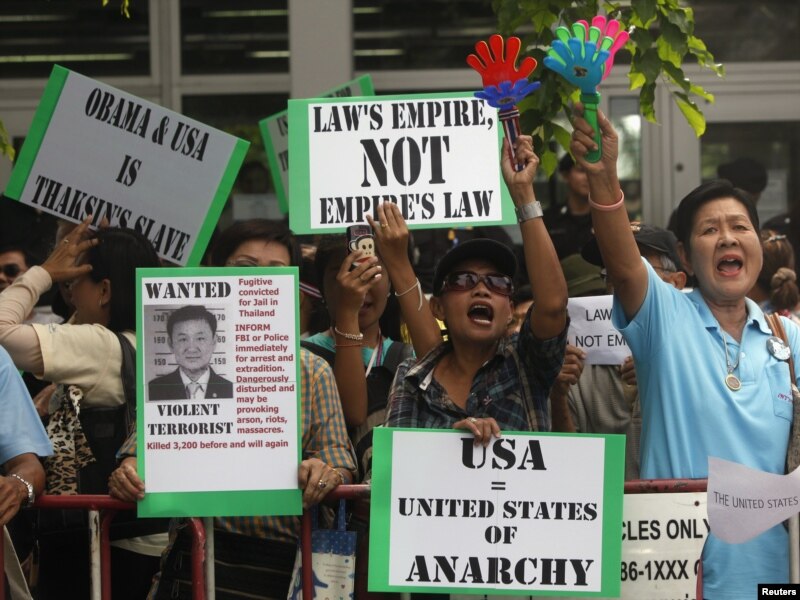
Former Thai Leader's US Visit Renews Calls for Justice

Members of Nation Associate Anti-Corruption Network rally against former Prime Minister Thaksin Shinawatra's visit to America outside the U.S. embassy in Bangkok, August 10, 2012.

Daniel Schearf
BANGKOK — Former Thai Prime Minister Thaksin Shinawatra has been visiting the United States on his first trip to the country since he was ousted in a coup in 2006.

His opponents have been demanding Washington revoke his visa and extradite the former leader to Thailand, where he faces jail time for conflict of interest charges from his time as leader.

The opposition Democrats have urged the Thai government to push the United States, a close ally of Thailand, for his arrest and extradition. On Friday, a group of about 200 protesters gathered outside the U.S. Embassy in Bangkok making the same demand.

The demonstrators held banners and signs reading “Ugly American” and “What Rule of Law?”

Mongkolkit Suksintharanon, secretary of a group calling itself the Nation Associate Anti-Corruption Network, says in two weeks they will be back for answers. And he added they are calling on the United States to revoke Thaksin's visa immediately.

Walter Braunohler, the U.S. Embassy spokesman in Bangkok, says they welcome Thai people’s right to protest peacefully. But, as a policy, they cannot discuss individual visa cases.

“I can’t talk about the specifics of any one case, but I can say that the issuance of a U.S. visa does not imply any position on Thailand’s internal matters,” Braunohler said.

Thaksin last visited the United States in 2006 as prime minister.  But, in his absence, the military ousted him in a coup.

His detractors, the royalist Yellow Shirts, say Thaksin was corrupt and power hungry. His supporters, known as the Red Shirts, say Bangkok elites viewed his growing popularity among the rural masses as a threat to their power.

In 2010, the Red Shirts occupied parts of Bangkok demanding new elections. Clashes with the military left 90 people dead. Elections last year put in office Thaksin’s sister, Yingluck Shinawatra.

Critics say her brother is really in charge, while she says Thaksin is just an advisor.

Thai Foreign Ministry spokesman Sek Wannamethee  says the government has no plans to seek Thaksin’s extradition.

“His trip to the United States is a private visit. And, we were never, the Thai government was never informed, nor were we aware of his program. As for his travels abroad, the Thai government, we don’t have a policy of restricting his traveling abroad.”

Prime Minister Yingluck Shinawatra’s ruling Pheu Thai party has been pushing for laws they say would help reconcile Thailand’s political divisions. Opponents say they are designed to grant amnesty to Thaksin so he could return to Thai politics.

The former leader's one week visit included stops in New York and California, among others. He was greeted by both Red Shirt supporters and Yellow Shirt opponents.

In Los Angeles, Thai media report, anti-Thaksin protesters blocked his route preventing him from giving a speech to supporters.

วันจันทร์ที่ 13 สิงหาคม พ.ศ. 2555

Three new wharfs planned for Ahlone Port


  Rangoon (Mizzima) – The Ahlone Dockyard Port will significantly expand with the construction of three new wharfs valued at more than US$ 110 million.

A section of Dalah port, Rangoon, Burma. Photo: Nay Lin Aung / Mizzima
Transport Minister Nyan Tun Aung said the work will be done in cooperation with Myanmar Annawar Swan Ah Shin Groups Company Limited, in a signing ceremony at Sedona Hotel in Rangoon.

Ko Ko Htoo, the managing director of the Myanmar Annawar Swan Ah Shin Groups Company Limited, said the three wharfs are designed to serve six [3,500-ton] vessels in simultaneous berths at the port, representing a total storage capacity of about 320,000 containers.

According to the Inland Water Transport website, the facility can now accommodate 16 vessels.

Earlier, the company built wharfs in the port facility, and it will operate the expanded facility under a long-term lease agreement, said Cho Than Maung, the managing director of Myanma Port Authority.

Transport Minister Nyan Tun Aung said in the signing ceremony that permitting private companies to run such facilities encourages private businesses and it is in line with other Asean countries’ economies.

Rangoon now has 18 wharfs, he said, and 14 more wharfs will be built.

Authorities are also planning new wharfs for the Thilawa Port in Thanlyin Township.

SR. PARTICULAR NUMBER OF SLIPWAYS CAPACITY
MAX: LIGHT WEIGHT
FOR DOCKING
1 Dalla dockyard 14 22 vessels 1400 tons
2 Ahlone dockyard 7 16 vessels 250 tons
3 Mandalay dockyard 1 5 vessels 300 tons
4 Thanlwin dockyard 1 2 vessels 300 tons
5 Sittwe dockyard 1 5 vessels 250 tons
6 Chindwin dockyard 1 3 vessels 250 tons

Total 25 53 vessels

Thai student among death row inmates in Vietnam

Embassy holds out little hope of reprieve

HANOI : A Thai diplomat in Vietnam has warned Thais not to attempt to smuggle drugs into the communist nation as traffickers face execution if they are caught.
Preeyanooch Phuttharaksa, immediately after her death sentence was passed by a court in Ho Chi Minh City, and her old photo from MySpace. (Main photo from Sports & Culture newspaper, Hanoi)

Charge d'affaires Boonrong Pongstiensak said Vietnam's anti-drug laws are among the world's harshest, and that many foreign prisoners are currently on death row in Vietnam, mostly on drug trafficking convictions.
"Even Vietnamese drug convicts face execution," he said.
Mr Boonrong told the Bangkok Post that the Thai embassy in Vietnam is working to help Preeyanooch Phuttharaksa, 23, a Thai college student from Bangkok who was sentenced to death for drug trafficking by Ho Chi Minh City court in June this year.
Preeyanooch was arrested for trafficking three kilogrammes of methamphetamine pills from Nigeria's Benin city into Vietnam through Saigon airport last October.
She was arrested after the drugs were found in a false bottom of her suitcase.
Police at Ho Chi Minh airport took this photo of Preeyanooch the day she was arrested last October for smuggling 3kg of drugs.
She told the court she was paid about US$1,570 (about 50,000 baht) by a Nigerian trafficking ring to smuggle the drugs.
Mr Boonrong said Preeyanooch had appealed for a reduced sentence on the advice of the Thai embassy in Vietnam.
He said the embassy was waiting for the Vietnamese president's decision on whether to reduce her death sentence to life imprisonment.

But Mr Boonrong said a reduced sentence would be difficult to obtain as drug trafficking is considered a most serious offence in Vietnam.

Mr Boonrong said four other Thais arrested for drugs trafficking are now being detained in prisons in Ho Chi Minh City and Hanoi.
They are awaiting trial, having been charged with smuggling methamphetamine pills into Vietnam.
Mr Boonrong did not give further details about these four suspects. He said the embassy in Hanoi is waiting for a response to a letter it sent to Vietnamese authorities asking them to allow Thai officials to visit the suspects.
He said visiting Thai inmates in Vietnam was difficult as it took a long time to obtain the necessary permission.
Mr Boonrong said he had received information that many Thai women are being deceived into trafficking drugs by international drugs gangs.

Permpong Chavalit, deputy secretary-general of the Office of the Narcotics Control Board, said the Foreign Ministry recently reported that about 100 Thai women are currently being detained for drug trafficking in several countries, including China, India, United Arab Emirates, Spain, Brazil and South Africa.
Some of them had married citizens of African countries and were forced to become involved in the trans-national drug trade, while others were willing to act as drug couriers due to the high pay, he said.

He said African drug syndicates are using Thailand as their base, and that African gangsters used different tactics to dupe Thai women into the drug trade.

Mr Permpong warned Thai women to stay away from African men to save themselves from being tricked into becoming a part of the drug networks.

วันอาทิตย์ที่ 12 สิงหาคม พ.ศ. 2555

As Rangoon Races Forward, a Push to Preserve Its Architectural Past

Unbridled development could hasten the destruction the city's remarkable, colonial-era structures.
Brendan Brady

The turquoise building in the background was built circa 1900 to house the Currency Department. Today it houses a city court
The neoclassical complex known as Sofaer’s Buildings was designed by a Baghdad-born Jewish trader and once housed a Reuters Telegram office and stores selling Egyptian cigarettes, German beer and English candies. Sofaer’s was constructed in central Rangoon in the early 1900s and in its first decades it served the international population that controlled the upper echelons of British-controlled Burma’s social, political and economic life. Like hundreds of its architectural contemporaries in the Southeast Asian country, Sofaer’s owes its provenance to the British invasion, in 1852, of what was then a fishing village. The British destroyed the community and remade it along a grid oriented around the waterfront  to create a new outpost for the empire.


A Burma Buddhist monk walks by the City Hall in downtown Yangon on August 13, 2010
(PHOTOS: The 11 Most Endangered Historic Places)
Today, the cream-yellow paint of Sofaer’s exterior is faded, peeling and in some sections entirely ensconced in soot and mildew. Its best-preserved section is occupied by an art gallery and government office, but the bulk of it houses a budget guesthouse, photocopy shops, a hodgepodge of vendors, or is vacant. Decades of economic stasis has helped preserve the core of what is today the largest collection of late 19th century and early 20th century urban architecture anywhere in Southeast Asia. The reopening of Rangoon promises much-needed renewal but, conservationists worry, could hasten the destruction these remarkable structures
In 1948, shortly after the Second World War, the British Empire relinquished control of Burma. Promising stability and playing to Burman nationalism, a group of hardline generals took power in a coup in 1962 and nationalized the economy, expelling foreign companies (and most foreigners) in the process. Burma, also known as Myanmar, has since become the second-poorest country in Asia. In Rangoon, which today is still Burma’s largest city and commercial center, roving blackouts remain routine, sewers are exposed and potholes pepper the roads. Aging buildings that might have been demolished in other cities in favor of high-rises or malls have remained as they were.
A little over a year ago, the junta handed power over to a semi-civilian government, which over the past year has enacted a sweeping series of reforms: releasing hundreds of political prisoners of conscience and easing draconian restrictions on political association, civil society and the press. The Nobel laureate Aung San Suu Kyi, who spent much of the last 20 years under house arrest, is now a member of parliament. Western countries have, in return, suspended their sanctions, re-opening Burma to international investors. The country is being trumpeted in business circles as one of the world’s last virgin markets, with vast stores of natural resources still ripe for the taking.

AP
Electric fans rotate above rattan chairs surrounding tables at the cozy coffee shop of Strand Hotel, July 22, 2008 in Yangon City's port area in Myanmar
 
To date, the only successful large-scale renovation of a colonial-era structure is the riverfront Strand Hotel: it was one of Asia’s most luxurious hotels when it was built in 1901 and after extensive rehabilitation in the early 90s has regained that stature, and despite lofty rates is popular again with well-heeled travelers precisely because it was authentically restored.
Many investors, Burmese and foreign, value the real estate of colonial-era buildings for their prime downtown locations and view the low-lying structures as an impediment to their plans for soaring apartment blocks and office towers, says Sun Oo, vice-chairman of the Architects Association of Myanmar. He worries some investors with “a very thick book of project proposals” will sway government officials to grant them demolition licenses. “I feel we are a few steps behind the developers.”

(PHOTOS: The 2012 World Monuments Fund Watch List)
To counter the risk of unbridled development, a band of historians, business representatives and architects, Sun Oo included, recently formed the Yangon Heritage Trust, a non-profit group to lobby and propose plans for preserving the traditional cityscape of Rangoon’s oldest districts. “We have this very unique situation where in one square mile in downtown Yangon we have both an Anglican cathedral and a Roman Catholic cathedral, two pagodas, seven mosques (Sunni and Shia), a Jewish synagogue, seven Hindu temples, Sikh, Parsi and Jain temples, and an Armenian church,” says the Heritage Trust’s founder, Thant Myint-U, a prominent historian and author. “And I think even in New York or London you’d be hard-pressed to find a square mile with that diversity of faiths represented.”
Kyaw Latt, a former architect who now serves as an advisor to Rangoon’s city council, says the recent efforts of conservationists have made an impact. “The city council is now conscious [of] the fact that we should preserve our city.” He acknowledges, however, that there are still few safeguards in place: most conspicuously, zoning laws are non-existent. And though 189 buildings are listed by the city council as heritage sites, hundreds more impressive structures from the same era remain without any official recognition.

Ye Aung Thu / AFP / Getty Images
People cross a road in front of the 1905-built Myanmar Port Authority building in downtown Yangon on Jun. 7, 2012
 
There is also the issue of popular support for saving these structures. If in colonial times Rangoon stood as an expression, in the mind of the British, of the empire’s order and prosperity, most Burmese experienced the city as second-class citizens. “All gentlemen interested in general society are eligible,” stated the membership rules of the Pegu Club, constructed in 1882, mostly of teak.  It was a given, though, by the standards of the social club’s gin-drinking British board members, that Burmese were not welcome. The architect Sun Oo, now 57, recalls that during the early years of military rule, the junta would deride relics of the colonial era by invoking the indignity of being looked down upon by foreign rulers.
But, regardless of their origins and original exclusions, says Thant Myint-U, “these are buildings that have spent most of their lifetimes in independent Burmese times. These are buildings where maybe one initial use was as a [foreign-owned and patronized] company in British times but since have gone through many incarnations and been the offices of many famous Burmese people.” Perhaps no building better embodies this shifting historical tenure from British to Burmese than the Secretariat. The sprawling Victorian complex was initially the seat of the British colonial government but it became a centerpiece of Burmese independence: it’s where independence leader General Aung San was assassinated in 1947 and subsequently the administrative center of the new government. A proposal earlier this year to convert the now-vacant Secretariat into a hotel ignited a public outcry. The people of Rangoon, says Thant Myint-U,  were saying the building was theirs.

 MORE: Five Reasons to Visit Rangoon
------------------------------------------------------------------

วันเสาร์ที่ 11 สิงหาคม พ.ศ. 2555

China firm proposes.....in cambodia

120808_07b

Chinese ambassador to Cambodia, Pan Guangxue, with Prime Minister Hun Sen. Photograph: Vireak Mai/ Phnom Penh Post
Chinese firms have huge ambitions for Cambodia, with a second firm this week proposing three projects worth an estimated US$6.5 billion to the National Assembly yesterday, but no deadlines were set for the implementation of the projects, according to officials.

Pan Xiaoping, chairman of Ruijin Investment Holding Ltd, based in  the Chinese province of Hainan, yesterday met with the president of the National Assembly, Heng Samrin, to seek the support for his company’s investment projects, said Kaom Kosal, cabinet director for the National Assembly.

The announcement comes after Shangdong Shuitai, a major farm machinery manufacturer from China, spoke with the National Assembly on Monday about investing in the Kingdom’s agriculture sector.

Earlier this year Chinese food company Hainan Agpro Inc announced its intentions to spend $500 million in Cambodia’s agriculture, it was reported.

“They (Ruijin Investment Holding Ltd) came with the intention to invest in Cambodia in three sectors – agriculture, tourism and infrastructure,” Koam said.

The first project is a rice plantation worth approximately $400 million; the second is a tourism investment project called Sihanouk-Hainan City, a resort and associated infrastructure worth a reported $5.8 billion; and the third project is focused on animal husbandry, namely cows, and is worth an estimated $300 million.

All three projects would last 10 years, he said, and come on the heels of China and Cambodia signing a $2.5 billion bilateral trade deal at the end of 2011 that aims to reach $7 billion by 2015, according to the Chinese Embassy.

Koam reported that at the meeting Pan Xiaoping described  Ruijin’s plans to open an office in Cambodia with the cooperation of RAT Sokhorn Inc Co Ltd.

In an effort to avoid land disputes the development of Sihanouk-Hainan City would only be done on land specifically purchased for the project, Koam said, but did not elaborate on what guarantees this would bring.

Chea Chantevy, assistant to Rat Sokhorn, president of Rat Sokhorn Incorporation Co said it was too early to reveal the details of the projects as it was only the first meeting between both companies and Cambodian government officials.

“We cannot disclose the project details right now, but Rat Sokhorn is working in conjunction with Ruijin Investment in order to invest in the agriculture and tourism sectors,” she said.

Agpro plans to conduct feasibility studies in a number of provinces, including Koh Kong and Preak Vihear, with the $500 million investment spread out over 10 years, while Shangtui aims to invest in rice and rubber plantations.

Ruijin Investment Holding Ltd has a sparse web presence in Chinese-language media, though Xinhua, the Chinese news organ, has reported on the meeting as well.

Traditional Khmer music

120808_03

Traditional Khmer instrumentalists. Photograph: Ven Sakol/ Phnom Penh Post
Traditional Khmer music is very special to the Khmer heritage, used both for entertainment and in traditional ceremonies. Some say it is as valuable as Angkor Wat.

For many centuries, Cambodia has been admired for the creativity of its Khmer ancestors. But despite the interest from abroad, the popularity of Khmer traditional music has declined sharply amongst youth in the country.

Nhuk Sinat is a Khmer traditional music teacher at Khmer Amatak association and Asia Organization. He said: “The value of our traditional music is comparable to Angkor Wat. It is our national heritage.”

Some students are still very proud of the music. Chheang Phirom, 22, a drama student at the Royal University of Fine Arts is one. He said he would love to learn to play Khmer music. “First, I thought it was something that I was made to do. But now, I know that I love Khmer traditional music and want to preserve it.”

But despite the willingness of students like Chheang, many young people are less interested. Low pay and lack of jobs discourages people from learning while people who play very well often become buskers in the city. Mr Oun has been a Khmer music player at wedding ceremonies for more than 20 years said he would not teach his children.

Some blame the drive to modernisation in the country for indifference towards the music. Yun Theara, deputy director general at the Ministry of Culture and Fine Arts said: “Youth are willing to get something and to be modern, and we cannot blame them.”

A growing number of Cambodian young people can watch Western or Korean hip hop, films and music on television but there are very few programs that show our traditional music.

But we as Khmers have a responsibility to save our heritage. Without the Khmer traditional music, our society will lose a national symbol, and much more besides. So what can we do to preserve it?

Yun Thean believes that the merging of ASEAN countries over the next few years means it is important to gather and record tradition.

He said: “In 2015, ASEAN countries will merge their culture. That is why we are first gathering and recording our traditional songs to document them. Secondly, we will focus on the media to reach schools and organisations.”

“Although youngsters nowadays do not know how to play the instrument, of they want to learn in their old age, they still can learn as long as we have the records.”

According to Thong Keo Bunnate, planning officer at Phnom Penh Municipal Department of Education, Youth and Sports, there is a school for learning Khmer traditional musical instrument for those who are willing to learn: the Royal University of Fine Arts. Schools that are under the Ministry of Education, Youth, and Sports also have the subject in Art Class but students can only learn the theory, rather than the practice.

Recognising the problem, the Westline School is preparing to add a new subject about Khmer traditional musical instruments into the school curriculums.

Pech Bolene, president of both the Westline School and the Northline School said: “We are going to have this new art class because our traditional songs are melodious and full of meaning, which is so interesting. That is why we want the new generation to know, learn, and preserve our traditional musical instrument.”

Some musicians also create new songs by mixing both modern and traditional musical instruments. Pagodas also play a role in preserving our traditional instruments.

For example, Teacher Sinat had a chance to study in Phnom Penh because of Reachbo Pagoda that taught him to play musical instruments from an early age.

We, as Khmer, have to preserve our traditional musical instruments or to raise awareness of their importance so that we do not lose our precious heritage.

The new three-wheeled tuk-tuks

120808_17
The new three-wheeled tuk-tuks, which come from India, are made in factories and equipped with fire extinguishers and come in yellow, black and green. Photograph: Roth Meas/Phnom Penh Post
 
Smaller, faster and made in India – meet the new-look that has hit the streets of Phnom Penh. A group of the dark green, yellow or black and three-wheeled tuk-tuks is on the roads in the city on a mission to convert drive.

More fuel-efficient than the traditional Cambodian vehicle and equipped with fire extinguishers and spare wheels, the new factory-made tuk-tuks are being touted as the maintainable alternative to local, hand-made vehicles.

Two months ago, an Indian compan, Bajaj Viper Auto, the world’s third-largest manufacturer of motorbikes, exported their business to the country with an offshoot called Viper Auto Cambodia.

They have brought the first 20 new tuk-tuks to Cambodia and at the end of this month, they will import more with the intention of replacing local tuk-tuks.

Pen Sopheak, the administrator in charge of imports at Vipar Auto Cambodia, said that the new tuk-tuks are safer than the locally made version.

“Local tuk-tuks cannot brake to stop in three metres if they are running fast. But our tuk-tuk can do so because it has the same brakes as a car,” Sopheak said.

But the vehicle is unlikely to fit more than two passengers, unlike local tuk-tuks which can carry four easily and even five or six at a push.

Sopheak said that passengers will find the new tuk-tuks more comfortable, although there is not much space for tourists to stow luggage.

Vipar Auto Cambodia keeps its 20 tuk-tuks at Stueng Meanchey commune, where the further 20 will also be kept when they arrive. Seven have already been sold to drivers.

During the current promotion they will be sold for $2,500 US dollars but after it finishes he’ll sell them for $3,000.

He has also sent some of the tuk-tuks to Siem Reap province where he believes the high levels of tourists means there will be a strong demand.

But tuk-tuk drivers who have tested the new stock say that imported tuk-tuks are unlikely to replace the local vehicles.

Sok Vichet, 45, who has driven tuk-tuks in Phnom Penh for three years, said that people will prefer the local tuk-tuks, which can carry four passengers with some luggage comfortably.

“They brought those ‘Indian tuk-tuks’ to display next to us and asked us to try. I decided that it would not be better than local tuk-tuks. Our tuk-tuk is higher, larger, and able to carry more people,” he said.

The new tuk-tuks are almost double the price of the cheapest vehicles sold locally. Drivers say the price is not a problem, but the fact that the new vehicles are produced abroad will deter sales.

Sok Vichet said that none of his friends who also work as drivers has changed to the Indian make. He believes that local tuk-tuks attract tourists because they were locally produced, and are part of the national identity.

“I’m sure some foreigners who come to Cambodia would like to try the vehicles invented by local people, so I don’t think I’ll change mine to the imported one,” he said.

The new tuk-tuks are more expensive but can go faster, and consume less gas.

The imported tuk-tuks, the RE145D model, is a two passenger carrier, with four foward gears and four reverse gears. Running on petrol, it has an average speed of about 55 kilometers per hour. On one litre of gasoline it can travel up to 45 kilometres.

Local tuk-tuks are cheaper, usually sold for between $1,600 and $2,500. They have only one brake, can drive at up to 40 kilometres per hour and guzzle a great deal of petrol – between 20 and 30 kilometres per litre.

They were converted from the longer carts pulled by motorbike known as remmorks.

The word tuk-tuk is likely to have been brought over from Thailand.

To contact the reporter on this story: Roth Meas at ppp.lifestyle@gmail.com

Emotions run deep at mass grave

100810_06a

People in Siem Reap province yesterday make offerings to the remains of victims who are thought to have been killed by the Khmer Rouge. Photograph: Heng Chivoan/Phnom Penh Post
Lat Ngi struggled to explain to her daughter the significance of what she was holding.

“This is your grandfather,” she told the little girl, holding a 15-centimetre jaw bone segment out to the incredulous child.

“I know it is my father’s bone, because he had platinum covering his three teeth here,” the 40-year-old said, pointing to three decayed teeth pockets along the jaw. “I knew he was brought here, but I never imagined I would actually find him – I can’t find the words to say.”

Ngi, who now lives in Thailand’s Pattaya state, rushed to arrive at the site for yesterday’s ceremony for the spirits of the dead as soon as she heard the news about the recent unearthing of the Khmer Rouge-era execution pit.

A small crowd gathered around Ngi to confirm her remarkable discovery, some in awe, others in anguish.

For many, the uncovering of a mass grave in Kralanh district’s [Du Dantrei village] had inspired a measure of desperate hope to find the final remains of relatives who were executed or disappeared under the Khmer Rouge regime.

More than 300 villagers gathered at the now-halted soil excavation site to participate in the ceremony yesterday.

While monks led villagers in the blessing ritual, a small group of despairing Khmer Rouge survivors broke away to place a makeshift altar adorned with candles, a fresh pig’s head and fruit at the base of the pit where human remains, including children’s bones and 20 skulls, were dug up last weekend.

Sitting by the altar, first one, and then several more villagers began scratching at the ground with their bare hands. An older villager descended into the pit with a stick to break through the earth. In less than five minutes, the group had filled two large silver offering platters with bones, and Ngi had found her father.

However, not everyone was as fortunate as Ngi.

Vorn Mol, 57, recounted through a stream of tears that not only had she lost both her parents at this site, she had lost all four of her children, and had no way of being sure she could ever recover their exact remains.

“I don’t know what difficulty they went through before they died,” Mol, crouched in prayer, said. “I come here to dedicate to their spirits so that they will never see again what they got in this life.”

With a shaved head and cataracts creeping across her irises, Mol was vehement in stressing her wish that all remains in the area were exhumed and taken to a stupa for proper burial.

“I don’t want them buried in the mud like that,” she said. “I want to see all the skulls together in one stupa and to keep it as evidence.

“I want to request the Khmer Rouge court to find justice for these victims, and make all of the people responsible for their actions.”

According to Thuy Sam Oeut, 55, who was held at the nearby prison in a 30-person work group breaking stones, cadre conducted the executions early in the morning.

“Between 4am and 5am, I saw that they took young people and old people to this area,” Sam Oeut said. “The man who is in charge of this [….] I don’t know where he went after the regime failed.”

Many of the villagers claimed that from 1979 to early 1980, Vietnamese forces wiped out many of the former controlling Khmer Rouge cadre in the area.

Documentation Center of Cambodia director Youk Chhang told the Post on Monday that his researchers had known about the site since 1998 and had hoped it would be used for evidence at the court trying senior leaders and those most responsible for crimes during the Democratic Kampuchea period.

However, none of the villagers speaking with the Post yesterday recalled seeing or hearing of any tribunal investigators coming to the area.

Deputy village chief Moek Samkhan said he had paid a group of villagers five cans of rice per day in 1980 to excavate as many bones as they could find from the nearby furnace pit.

Rice husk and, during 1977 to 1979, humans – alive and dead – were incinerated in the pit to make fertiliser.

A thick blanket of gritty, black debris covers what remains of the 15-by-25-metre furnace pit and its surrounding area.

“We did this in 1980, and it took about one month to collect all the bones we could,” Samhan said. Those bones are now kept in cubic-metre cement containers in the shell of the former prison office on Trung Bat mountain, about 500 metres from the site of the latest discovery.

The unkempt structure is covered in graffiti and some of the cement cases are cracked and broken away, exposing the fragments of rock and bone within.

“We knew what happened there [at the furnace and prison], but we did not know there was more here too,” he said, adding he would work to fulfil the villagers’ wish that a memorial stupa be built in the area.

A stupa is pertinent, because memories will likely die with survivors, 83-year-old Kan Kimly said, her eyes blinking back tears as she spoke.

“I try to tell my grandchildren the stories, but they don’t believe,” she said, struggling to smile. “How can you believe what happened?

To contact the reporters on this story: May Titthara May Titthara at titthara.may@phnompenhpost.com and Bridget Di Certo at bridget.dicerto@phnompenhpost.com reporting from Siem Reap

Burma’s president helps fund ’88 24th anniversary event


Burma’s President Thein Sein personally sent two cabinet minister to hand over a check to a former political prisoner to help fund a 24th anniversary commemoration event of the 1988 protest movement held in Mandalay on Wednesday.

Burma's President Thein Sein Photo: President's office
Burma's President Thein Sein Photo: President's office 
Ko Ko Gyi, a prominent leader of the 1988 protest movement, said it was as if the newly elected government was also participating in the anniversary commemoration.

“I feel like this is a step toward reform,” he told The Associated Press. The ministers gave the 88-Student group a check for more than US$ 1,000.

Presidential spokesman Nay Zin Latt said the government recognized the anniversary as a “historic event” and the president wanted to show his sincerity about achieving national reconciliation.

“The president always talks about national reconciliation,” the spokesman said. “This action can help build better mutual understanding.”

Ko Ko Gyi, who spent years in prison following the bloody crackdown on the 1988 uprising, said the gathering called on the government to recognize the anniversary as a national “Day of Democracy” and demanded that the 88 Generation student leaders be allowed to take part in the country’s reform process, according to an article on the Radio Free Asia website on Thursday.

“After 24 years, we 88 Generation members must be part of the political transition in Burma,” he said.

Min Ko Naing, another 88 Generation student who was jailed in the aftermath of the 1988 military action that left as many as 3,000 people dead, according to some accounts, said the group’s focus was as sharp as ever, despite many of its leaders having spent decades in prison.

“Many 88 Generation students were sent to prison in different locations and their family life was disrupted by that. Many of our lives were thrown into disorder by this prison experience, but we never gave up, even though we were undergoing such harsh measures,” he said.

A similar anniversary event was also held in Rangoon and other areas of the country.

The demonstration that started on August 8, 1988, was a nationwide popular uprising known as the People Power Uprising, which unfolded as a series of marches, demonstrations, protests, and riots, ultimately suppressed by the killing of hundreds of demonstrators.

The 8888 uprising was started by students in Rangoon and spread throughout the country. Hundreds of thousands of ochre-robed monks, young children, university students, housewives, and doctors demonstrated against the regime.

The uprising ended on September 18, after a bloody military coup by the State Law and Order Restoration Council. Thousands of deaths have been attributed to the military during the uprising, while government authorities in Burma put the figure at around 350 people killed. Thousands more were jailed.

Prime Minister Hun Sen

100810_04

Prime Minister Hun Sen (L) gestures before delivering his speech at the National Assembly yesterday in Phnom Penh. Minister of Interior Sar Keng (2nd R) and Deputy Prime Minister Sok An (R) were also in attendance. Photograph: Pha Lina/Phnom Penh Post
Sometimes austere, other times ebullient, Prime Minister Hun Sen spent his rare, more than five-hour speech to parliament yesterday outlining a border demarcation plan with Vietnam and taunting the opposition before refusing to answer anything other than written questions.

Peppered with vitriolic outbursts at his critics, the premier’s speech to 103 lawmakers at the National Assembly focused on a plan for Cambodia and Vietnam to compensate one another with unoccupied land for villages it had been agreed fell in the opposing country’s territory.

“The choice is that we must keep the same situation according to the occupation [of areas] of people,” he said.

Land for exchange in Kampot, Kampong Cham and Takeo provinces had already been agreed upon by the two countries, while negotiations to do the same in Prey Veng and Svay Rieng provinces were under way, Hun Sen told the parliament.

Cambodians have been occupying 2,160.6 hectares of territory belonging to their eastern neighbour while Vietnamese are living on 916.7 hectares of land in the Kingdom, he added, stressing that exchanges would be equal, hectare for hectare.

The process of demarcation, the premier said, followed that which was laid down by King Father and former president Norodom Sihanouk, relying on maps devised by the French colonial administrations of Cochinchina (southern Vietnam) and Cambodia.

“I would like to say that with both land border and maritime border, we followed the map which Samdech Norodom Sihanouk deposited at the United Nations [in 1964],” he said.

“Your insults of Hun Sen are equal to insults of Sihanouk, because Hun Sen follows Sihanouk for all.”

National Assembly President Heng Samrin enacted his constitutional right to quash any debate during the session, though the premier did answer four written questions sent to him by Sam Rainsy Party whip Son Chhay more than six weeks prior.

Heng Samrin’s decision infuriated Son Chhay, who said Cambodia was undoubtedly alone amongst democracies around the world in having a parliament that was never allowed to debate anything.

“They don’t allow us to speak, they don’t allow us to ask questions, for five hours just listening to his threats – we’re really pissed off,” he said, adding that it was the first time in almost 20 years that Hun Sen had even answered a written question in parliament.

“If you don’t have any questions, you don’t call it question time, you call it propaganda time.”

The government, he said, was constantly violating Article 96 of the constitution by not responding to questions within a week or simply not answering at all, which had happened with 70 per cent of the letters he had sent.

Political analyst Lao Mong Hay said he felt the solution the government had presented to resolve the long-running process of demarcating the border with Vietnam was fair but also expressed disappointment about the premier’s conduct in parliament.

“We heard one side of the story, so we should be able to hear the other side as well,” he said.

In response to the written questions, Hun Sen clarified Cambodia’s position on once-disputed Phu Quoc Island, which is currently part of Vietnam but known by Cambodians as Koh Tral Phu Quoc, as well as two villages in Kampong Cham province.

The premier said Sihanouk had told former Vietnamese Prime Minister Pham Van Dong that Cambodia no longer demanded Koh Trol back in 1999, relinquishing the Kingdom’s right to the island.

Sihanouk’s personal adviser and secretary, Prince Thomico Sisowath, refused to comment on any discussion the king father might have had with Pham Van Dong in 1999 but said the map the king father had taken to the UN made no such concession.

“The map which the King took to deposit at the UN claimed that Koh Trol is in Khmer land. Cambodia denied that France took Koh Trol to give to Cochinchina,” he said. In June, senior minister in charge of the Cambodian Border Affairs Committee, Va Kimhong, said the government would have to cede two villages to Vietnam to keep Thlok Trach and Anlung Chrey villages in Kampong Cham province’s Ponhea Krek district.

Ever since, the opposition has been demanding to know which villages would be ceded in exchange for the territory that includes the birthplace of Heng Samrin.

But Hun Sen yesterday simply confirmed that part of Heng Samrin’s village was in Vietnamese territory and that the National Assembly president had been lobbying hard for it to remain in Cambodia, without explaining whether or not it would.

The Vietnamese Embassy in Phnom Penh did not reply to enquiries from the Post.

Not for the first time, Hun Sen accused Son Chhay of political skulduggery, rehashing his old claim that the lawmaker, whom he belittling referred to as his “younger brother”, had acted as “his little spy” in 1997 in exchange for US$10,000.

The premier took the allegation further yesterday, claiming 20 pages of documents and a CD recording proved Son Chhay had tipped him off about a plan to overthrow him in 1997.

“During that time, you reported [to me] about the military situation that was organised by [then-Funcinpec military commander] Nhek Bunchhay, Khan Saveoun and Ho Sok. It was a good report that made me have enough time to prevent the situation in advance,” he said.

Hun Sen, then second co-prime minister next to Funcinpec’s Prince Norodom Ranariddh, became Cambodia’s unopposed leader shortly after, following bloody factional fighting that the premier has repeatedly argued was not a coup d’etat.

Son Chhay said it was sad that the prime minister of Cambodia behaved in such a dishonest, undignified way in a speech broadcast across the country.

“This is a dirty game, this is a cheap thing, that this man has been using. So they play this game,” Chhay said, rejecting all Hun Sen’s accusations as complete rubbish.

Son Chhay has previously conceded that he did indeed accept US$10,000 from Hun Sen, but only when he returned to Cambodia in 1997, money he believed parliamentarians that had stayed had also be given.

Not taking the money, Son Chhay told the Post in December 2006, could have been seen as a “negative reaction” to a goodwill gesture from the premier and jeopardised his negotiations with Hun Sen to secure the return of other politicians who had fled.

To contact the reporters on this story: Meas Sokchea at sokchea.meas@phnompenhpost.com
David Boyle at david.boyle@phnompenhpost.comWith assistance from Vong Sokheng