วันอังคารที่ 14 สิงหาคม พ.ศ. 2555

Former Thai Leader's US Visit Renews Calls for Justice
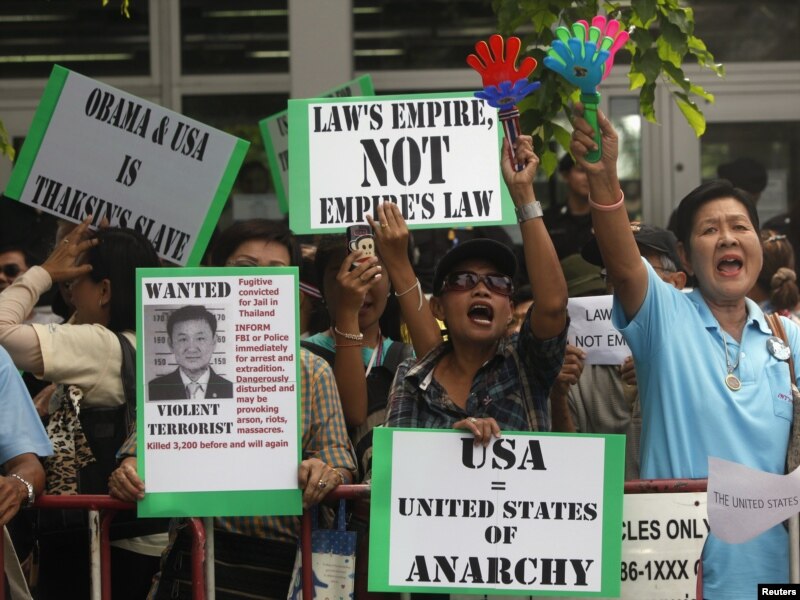
Members of Nation Associate Anti-Corruption Network rally against former Prime Minister Thaksin Shinawatra's visit to America outside the U.S. embassy in Bangkok, August 10, 2012.

Daniel Schearf
BANGKOK — Former Thai Prime Minister Thaksin Shinawatra has been visiting the United States on his first trip to the country since he was ousted in a coup in 2006.

His opponents have been demanding Washington revoke his visa and extradite the former leader to Thailand, where he faces jail time for conflict of interest charges from his time as leader.

The opposition Democrats have urged the Thai government to push the United States, a close ally of Thailand, for his arrest and extradition. On Friday, a group of about 200 protesters gathered outside the U.S. Embassy in Bangkok making the same demand.

The demonstrators held banners and signs reading “Ugly American” and “What Rule of Law?”

Mongkolkit Suksintharanon, secretary of a group calling itself the Nation Associate Anti-Corruption Network, says in two weeks they will be back for answers. And he added they are calling on the United States to revoke Thaksin's visa immediately.

Walter Braunohler, the U.S. Embassy spokesman in Bangkok, says they welcome Thai people’s right to protest peacefully. But, as a policy, they cannot discuss individual visa cases.

“I can’t talk about the specifics of any one case, but I can say that the issuance of a U.S. visa does not imply any position on Thailand’s internal matters,” Braunohler said.

Thaksin last visited the United States in 2006 as prime minister.  But, in his absence, the military ousted him in a coup.

His detractors, the royalist Yellow Shirts, say Thaksin was corrupt and power hungry. His supporters, known as the Red Shirts, say Bangkok elites viewed his growing popularity among the rural masses as a threat to their power.

In 2010, the Red Shirts occupied parts of Bangkok demanding new elections. Clashes with the military left 90 people dead. Elections last year put in office Thaksin’s sister, Yingluck Shinawatra.

Critics say her brother is really in charge, while she says Thaksin is just an advisor.

Thai Foreign Ministry spokesman Sek Wannamethee  says the government has no plans to seek Thaksin’s extradition.

“His trip to the United States is a private visit. And, we were never, the Thai government was never informed, nor were we aware of his program. As for his travels abroad, the Thai government, we don’t have a policy of restricting his traveling abroad.”

Prime Minister Yingluck Shinawatra’s ruling Pheu Thai party has been pushing for laws they say would help reconcile Thailand’s political divisions. Opponents say they are designed to grant amnesty to Thaksin so he could return to Thai politics.

The former leader's one week visit included stops in New York and California, among others. He was greeted by both Red Shirt supporters and Yellow Shirt opponents.

In Los Angeles, Thai media report, anti-Thaksin protesters blocked his route preventing him from giving a speech to supporters.

วันจันทร์ที่ 13 สิงหาคม พ.ศ. 2555

Three new wharfs planned for Ahlone Port


  Rangoon (Mizzima) – The Ahlone Dockyard Port will significantly expand with the construction of three new wharfs valued at more than US$ 110 million.

A section of Dalah port, Rangoon, Burma. Photo: Nay Lin Aung / Mizzima
Transport Minister Nyan Tun Aung said the work will be done in cooperation with Myanmar Annawar Swan Ah Shin Groups Company Limited, in a signing ceremony at Sedona Hotel in Rangoon.

Ko Ko Htoo, the managing director of the Myanmar Annawar Swan Ah Shin Groups Company Limited, said the three wharfs are designed to serve six [3,500-ton] vessels in simultaneous berths at the port, representing a total storage capacity of about 320,000 containers.

According to the Inland Water Transport website, the facility can now accommodate 16 vessels.

Earlier, the company built wharfs in the port facility, and it will operate the expanded facility under a long-term lease agreement, said Cho Than Maung, the managing director of Myanma Port Authority.

Transport Minister Nyan Tun Aung said in the signing ceremony that permitting private companies to run such facilities encourages private businesses and it is in line with other Asean countries’ economies.

Rangoon now has 18 wharfs, he said, and 14 more wharfs will be built.

Authorities are also planning new wharfs for the Thilawa Port in Thanlyin Township.

SR. PARTICULAR NUMBER OF SLIPWAYS CAPACITY
MAX: LIGHT WEIGHT
FOR DOCKING
1 Dalla dockyard 14 22 vessels 1400 tons
2 Ahlone dockyard 7 16 vessels 250 tons
3 Mandalay dockyard 1 5 vessels 300 tons
4 Thanlwin dockyard 1 2 vessels 300 tons
5 Sittwe dockyard 1 5 vessels 250 tons
6 Chindwin dockyard 1 3 vessels 250 tons

Total 25 53 vessels

Thai student among death row inmates in Vietnam

Embassy holds out little hope of reprieve

HANOI : A Thai diplomat in Vietnam has warned Thais not to attempt to smuggle drugs into the communist nation as traffickers face execution if they are caught.
Preeyanooch Phuttharaksa, immediately after her death sentence was passed by a court in Ho Chi Minh City, and her old photo from MySpace. (Main photo from Sports & Culture newspaper, Hanoi)

Charge d'affaires Boonrong Pongstiensak said Vietnam's anti-drug laws are among the world's harshest, and that many foreign prisoners are currently on death row in Vietnam, mostly on drug trafficking convictions.
"Even Vietnamese drug convicts face execution," he said.
Mr Boonrong told the Bangkok Post that the Thai embassy in Vietnam is working to help Preeyanooch Phuttharaksa, 23, a Thai college student from Bangkok who was sentenced to death for drug trafficking by Ho Chi Minh City court in June this year.
Preeyanooch was arrested for trafficking three kilogrammes of methamphetamine pills from Nigeria's Benin city into Vietnam through Saigon airport last October.
She was arrested after the drugs were found in a false bottom of her suitcase.
Police at Ho Chi Minh airport took this photo of Preeyanooch the day she was arrested last October for smuggling 3kg of drugs.
She told the court she was paid about US$1,570 (about 50,000 baht) by a Nigerian trafficking ring to smuggle the drugs.
Mr Boonrong said Preeyanooch had appealed for a reduced sentence on the advice of the Thai embassy in Vietnam.
He said the embassy was waiting for the Vietnamese president's decision on whether to reduce her death sentence to life imprisonment.

But Mr Boonrong said a reduced sentence would be difficult to obtain as drug trafficking is considered a most serious offence in Vietnam.

Mr Boonrong said four other Thais arrested for drugs trafficking are now being detained in prisons in Ho Chi Minh City and Hanoi.
They are awaiting trial, having been charged with smuggling methamphetamine pills into Vietnam.
Mr Boonrong did not give further details about these four suspects. He said the embassy in Hanoi is waiting for a response to a letter it sent to Vietnamese authorities asking them to allow Thai officials to visit the suspects.
He said visiting Thai inmates in Vietnam was difficult as it took a long time to obtain the necessary permission.
Mr Boonrong said he had received information that many Thai women are being deceived into trafficking drugs by international drugs gangs.

Permpong Chavalit, deputy secretary-general of the Office of the Narcotics Control Board, said the Foreign Ministry recently reported that about 100 Thai women are currently being detained for drug trafficking in several countries, including China, India, United Arab Emirates, Spain, Brazil and South Africa.
Some of them had married citizens of African countries and were forced to become involved in the trans-national drug trade, while others were willing to act as drug couriers due to the high pay, he said.

He said African drug syndicates are using Thailand as their base, and that African gangsters used different tactics to dupe Thai women into the drug trade.

Mr Permpong warned Thai women to stay away from African men to save themselves from being tricked into becoming a part of the drug networks.

วันอาทิตย์ที่ 12 สิงหาคม พ.ศ. 2555

As Rangoon Races Forward, a Push to Preserve Its Architectural Past

Unbridled development could hasten the destruction the city's remarkable, colonial-era structures.
Brendan Brady

The turquoise building in the background was built circa 1900 to house the Currency Department. Today it houses a city court
The neoclassical complex known as Sofaer’s Buildings was designed by a Baghdad-born Jewish trader and once housed a Reuters Telegram office and stores selling Egyptian cigarettes, German beer and English candies. Sofaer’s was constructed in central Rangoon in the early 1900s and in its first decades it served the international population that controlled the upper echelons of British-controlled Burma’s social, political and economic life. Like hundreds of its architectural contemporaries in the Southeast Asian country, Sofaer’s owes its provenance to the British invasion, in 1852, of what was then a fishing village. The British destroyed the community and remade it along a grid oriented around the waterfront  to create a new outpost for the empire.


A Burma Buddhist monk walks by the City Hall in downtown Yangon on August 13, 2010
(PHOTOS: The 11 Most Endangered Historic Places)
Today, the cream-yellow paint of Sofaer’s exterior is faded, peeling and in some sections entirely ensconced in soot and mildew. Its best-preserved section is occupied by an art gallery and government office, but the bulk of it houses a budget guesthouse, photocopy shops, a hodgepodge of vendors, or is vacant. Decades of economic stasis has helped preserve the core of what is today the largest collection of late 19th century and early 20th century urban architecture anywhere in Southeast Asia. The reopening of Rangoon promises much-needed renewal but, conservationists worry, could hasten the destruction these remarkable structures
In 1948, shortly after the Second World War, the British Empire relinquished control of Burma. Promising stability and playing to Burman nationalism, a group of hardline generals took power in a coup in 1962 and nationalized the economy, expelling foreign companies (and most foreigners) in the process. Burma, also known as Myanmar, has since become the second-poorest country in Asia. In Rangoon, which today is still Burma’s largest city and commercial center, roving blackouts remain routine, sewers are exposed and potholes pepper the roads. Aging buildings that might have been demolished in other cities in favor of high-rises or malls have remained as they were.
A little over a year ago, the junta handed power over to a semi-civilian government, which over the past year has enacted a sweeping series of reforms: releasing hundreds of political prisoners of conscience and easing draconian restrictions on political association, civil society and the press. The Nobel laureate Aung San Suu Kyi, who spent much of the last 20 years under house arrest, is now a member of parliament. Western countries have, in return, suspended their sanctions, re-opening Burma to international investors. The country is being trumpeted in business circles as one of the world’s last virgin markets, with vast stores of natural resources still ripe for the taking.

AP
Electric fans rotate above rattan chairs surrounding tables at the cozy coffee shop of Strand Hotel, July 22, 2008 in Yangon City's port area in Myanmar
 
To date, the only successful large-scale renovation of a colonial-era structure is the riverfront Strand Hotel: it was one of Asia’s most luxurious hotels when it was built in 1901 and after extensive rehabilitation in the early 90s has regained that stature, and despite lofty rates is popular again with well-heeled travelers precisely because it was authentically restored.
Many investors, Burmese and foreign, value the real estate of colonial-era buildings for their prime downtown locations and view the low-lying structures as an impediment to their plans for soaring apartment blocks and office towers, says Sun Oo, vice-chairman of the Architects Association of Myanmar. He worries some investors with “a very thick book of project proposals” will sway government officials to grant them demolition licenses. “I feel we are a few steps behind the developers.”

(PHOTOS: The 2012 World Monuments Fund Watch List)
To counter the risk of unbridled development, a band of historians, business representatives and architects, Sun Oo included, recently formed the Yangon Heritage Trust, a non-profit group to lobby and propose plans for preserving the traditional cityscape of Rangoon’s oldest districts. “We have this very unique situation where in one square mile in downtown Yangon we have both an Anglican cathedral and a Roman Catholic cathedral, two pagodas, seven mosques (Sunni and Shia), a Jewish synagogue, seven Hindu temples, Sikh, Parsi and Jain temples, and an Armenian church,” says the Heritage Trust’s founder, Thant Myint-U, a prominent historian and author. “And I think even in New York or London you’d be hard-pressed to find a square mile with that diversity of faiths represented.”
Kyaw Latt, a former architect who now serves as an advisor to Rangoon’s city council, says the recent efforts of conservationists have made an impact. “The city council is now conscious [of] the fact that we should preserve our city.” He acknowledges, however, that there are still few safeguards in place: most conspicuously, zoning laws are non-existent. And though 189 buildings are listed by the city council as heritage sites, hundreds more impressive structures from the same era remain without any official recognition.

Ye Aung Thu / AFP / Getty Images
People cross a road in front of the 1905-built Myanmar Port Authority building in downtown Yangon on Jun. 7, 2012
 
There is also the issue of popular support for saving these structures. If in colonial times Rangoon stood as an expression, in the mind of the British, of the empire’s order and prosperity, most Burmese experienced the city as second-class citizens. “All gentlemen interested in general society are eligible,” stated the membership rules of the Pegu Club, constructed in 1882, mostly of teak.  It was a given, though, by the standards of the social club’s gin-drinking British board members, that Burmese were not welcome. The architect Sun Oo, now 57, recalls that during the early years of military rule, the junta would deride relics of the colonial era by invoking the indignity of being looked down upon by foreign rulers.
But, regardless of their origins and original exclusions, says Thant Myint-U, “these are buildings that have spent most of their lifetimes in independent Burmese times. These are buildings where maybe one initial use was as a [foreign-owned and patronized] company in British times but since have gone through many incarnations and been the offices of many famous Burmese people.” Perhaps no building better embodies this shifting historical tenure from British to Burmese than the Secretariat. The sprawling Victorian complex was initially the seat of the British colonial government but it became a centerpiece of Burmese independence: it’s where independence leader General Aung San was assassinated in 1947 and subsequently the administrative center of the new government. A proposal earlier this year to convert the now-vacant Secretariat into a hotel ignited a public outcry. The people of Rangoon, says Thant Myint-U,  were saying the building was theirs.

 MORE: Five Reasons to Visit Rangoon
------------------------------------------------------------------

วันเสาร์ที่ 11 สิงหาคม พ.ศ. 2555

China firm proposes.....in cambodia

120808_07b

Chinese ambassador to Cambodia, Pan Guangxue, with Prime Minister Hun Sen. Photograph: Vireak Mai/ Phnom Penh Post
Chinese firms have huge ambitions for Cambodia, with a second firm this week proposing three projects worth an estimated US$6.5 billion to the National Assembly yesterday, but no deadlines were set for the implementation of the projects, according to officials.

Pan Xiaoping, chairman of Ruijin Investment Holding Ltd, based in  the Chinese province of Hainan, yesterday met with the president of the National Assembly, Heng Samrin, to seek the support for his company’s investment projects, said Kaom Kosal, cabinet director for the National Assembly.

The announcement comes after Shangdong Shuitai, a major farm machinery manufacturer from China, spoke with the National Assembly on Monday about investing in the Kingdom’s agriculture sector.

Earlier this year Chinese food company Hainan Agpro Inc announced its intentions to spend $500 million in Cambodia’s agriculture, it was reported.

“They (Ruijin Investment Holding Ltd) came with the intention to invest in Cambodia in three sectors – agriculture, tourism and infrastructure,” Koam said.

The first project is a rice plantation worth approximately $400 million; the second is a tourism investment project called Sihanouk-Hainan City, a resort and associated infrastructure worth a reported $5.8 billion; and the third project is focused on animal husbandry, namely cows, and is worth an estimated $300 million.

All three projects would last 10 years, he said, and come on the heels of China and Cambodia signing a $2.5 billion bilateral trade deal at the end of 2011 that aims to reach $7 billion by 2015, according to the Chinese Embassy.

Koam reported that at the meeting Pan Xiaoping described  Ruijin’s plans to open an office in Cambodia with the cooperation of RAT Sokhorn Inc Co Ltd.

In an effort to avoid land disputes the development of Sihanouk-Hainan City would only be done on land specifically purchased for the project, Koam said, but did not elaborate on what guarantees this would bring.

Chea Chantevy, assistant to Rat Sokhorn, president of Rat Sokhorn Incorporation Co said it was too early to reveal the details of the projects as it was only the first meeting between both companies and Cambodian government officials.

“We cannot disclose the project details right now, but Rat Sokhorn is working in conjunction with Ruijin Investment in order to invest in the agriculture and tourism sectors,” she said.

Agpro plans to conduct feasibility studies in a number of provinces, including Koh Kong and Preak Vihear, with the $500 million investment spread out over 10 years, while Shangtui aims to invest in rice and rubber plantations.

Ruijin Investment Holding Ltd has a sparse web presence in Chinese-language media, though Xinhua, the Chinese news organ, has reported on the meeting as well.

Traditional Khmer music

120808_03

Traditional Khmer instrumentalists. Photograph: Ven Sakol/ Phnom Penh Post
Traditional Khmer music is very special to the Khmer heritage, used both for entertainment and in traditional ceremonies. Some say it is as valuable as Angkor Wat.

For many centuries, Cambodia has been admired for the creativity of its Khmer ancestors. But despite the interest from abroad, the popularity of Khmer traditional music has declined sharply amongst youth in the country.

Nhuk Sinat is a Khmer traditional music teacher at Khmer Amatak association and Asia Organization. He said: “The value of our traditional music is comparable to Angkor Wat. It is our national heritage.”

Some students are still very proud of the music. Chheang Phirom, 22, a drama student at the Royal University of Fine Arts is one. He said he would love to learn to play Khmer music. “First, I thought it was something that I was made to do. But now, I know that I love Khmer traditional music and want to preserve it.”

But despite the willingness of students like Chheang, many young people are less interested. Low pay and lack of jobs discourages people from learning while people who play very well often become buskers in the city. Mr Oun has been a Khmer music player at wedding ceremonies for more than 20 years said he would not teach his children.

Some blame the drive to modernisation in the country for indifference towards the music. Yun Theara, deputy director general at the Ministry of Culture and Fine Arts said: “Youth are willing to get something and to be modern, and we cannot blame them.”

A growing number of Cambodian young people can watch Western or Korean hip hop, films and music on television but there are very few programs that show our traditional music.

But we as Khmers have a responsibility to save our heritage. Without the Khmer traditional music, our society will lose a national symbol, and much more besides. So what can we do to preserve it?

Yun Thean believes that the merging of ASEAN countries over the next few years means it is important to gather and record tradition.

He said: “In 2015, ASEAN countries will merge their culture. That is why we are first gathering and recording our traditional songs to document them. Secondly, we will focus on the media to reach schools and organisations.”

“Although youngsters nowadays do not know how to play the instrument, of they want to learn in their old age, they still can learn as long as we have the records.”

According to Thong Keo Bunnate, planning officer at Phnom Penh Municipal Department of Education, Youth and Sports, there is a school for learning Khmer traditional musical instrument for those who are willing to learn: the Royal University of Fine Arts. Schools that are under the Ministry of Education, Youth, and Sports also have the subject in Art Class but students can only learn the theory, rather than the practice.

Recognising the problem, the Westline School is preparing to add a new subject about Khmer traditional musical instruments into the school curriculums.

Pech Bolene, president of both the Westline School and the Northline School said: “We are going to have this new art class because our traditional songs are melodious and full of meaning, which is so interesting. That is why we want the new generation to know, learn, and preserve our traditional musical instrument.”

Some musicians also create new songs by mixing both modern and traditional musical instruments. Pagodas also play a role in preserving our traditional instruments.

For example, Teacher Sinat had a chance to study in Phnom Penh because of Reachbo Pagoda that taught him to play musical instruments from an early age.

We, as Khmer, have to preserve our traditional musical instruments or to raise awareness of their importance so that we do not lose our precious heritage.

The new three-wheeled tuk-tuks

120808_17
The new three-wheeled tuk-tuks, which come from India, are made in factories and equipped with fire extinguishers and come in yellow, black and green. Photograph: Roth Meas/Phnom Penh Post
 
Smaller, faster and made in India – meet the new-look that has hit the streets of Phnom Penh. A group of the dark green, yellow or black and three-wheeled tuk-tuks is on the roads in the city on a mission to convert drive.

More fuel-efficient than the traditional Cambodian vehicle and equipped with fire extinguishers and spare wheels, the new factory-made tuk-tuks are being touted as the maintainable alternative to local, hand-made vehicles.

Two months ago, an Indian compan, Bajaj Viper Auto, the world’s third-largest manufacturer of motorbikes, exported their business to the country with an offshoot called Viper Auto Cambodia.

They have brought the first 20 new tuk-tuks to Cambodia and at the end of this month, they will import more with the intention of replacing local tuk-tuks.

Pen Sopheak, the administrator in charge of imports at Vipar Auto Cambodia, said that the new tuk-tuks are safer than the locally made version.

“Local tuk-tuks cannot brake to stop in three metres if they are running fast. But our tuk-tuk can do so because it has the same brakes as a car,” Sopheak said.

But the vehicle is unlikely to fit more than two passengers, unlike local tuk-tuks which can carry four easily and even five or six at a push.

Sopheak said that passengers will find the new tuk-tuks more comfortable, although there is not much space for tourists to stow luggage.

Vipar Auto Cambodia keeps its 20 tuk-tuks at Stueng Meanchey commune, where the further 20 will also be kept when they arrive. Seven have already been sold to drivers.

During the current promotion they will be sold for $2,500 US dollars but after it finishes he’ll sell them for $3,000.

He has also sent some of the tuk-tuks to Siem Reap province where he believes the high levels of tourists means there will be a strong demand.

But tuk-tuk drivers who have tested the new stock say that imported tuk-tuks are unlikely to replace the local vehicles.

Sok Vichet, 45, who has driven tuk-tuks in Phnom Penh for three years, said that people will prefer the local tuk-tuks, which can carry four passengers with some luggage comfortably.

“They brought those ‘Indian tuk-tuks’ to display next to us and asked us to try. I decided that it would not be better than local tuk-tuks. Our tuk-tuk is higher, larger, and able to carry more people,” he said.

The new tuk-tuks are almost double the price of the cheapest vehicles sold locally. Drivers say the price is not a problem, but the fact that the new vehicles are produced abroad will deter sales.

Sok Vichet said that none of his friends who also work as drivers has changed to the Indian make. He believes that local tuk-tuks attract tourists because they were locally produced, and are part of the national identity.

“I’m sure some foreigners who come to Cambodia would like to try the vehicles invented by local people, so I don’t think I’ll change mine to the imported one,” he said.

The new tuk-tuks are more expensive but can go faster, and consume less gas.

The imported tuk-tuks, the RE145D model, is a two passenger carrier, with four foward gears and four reverse gears. Running on petrol, it has an average speed of about 55 kilometers per hour. On one litre of gasoline it can travel up to 45 kilometres.

Local tuk-tuks are cheaper, usually sold for between $1,600 and $2,500. They have only one brake, can drive at up to 40 kilometres per hour and guzzle a great deal of petrol – between 20 and 30 kilometres per litre.

They were converted from the longer carts pulled by motorbike known as remmorks.

The word tuk-tuk is likely to have been brought over from Thailand.

To contact the reporter on this story: Roth Meas at ppp.lifestyle@gmail.com